Make Your Job a Calling

  • Contact
  • Templeton Press

Menu

  • Stories of Calling
    • Share Yours
  • About
    • Contact
    • The Book
    • The Authors
    • Book Extras
  • News
    • Research
    • Schedule
    • Reviews
  • Tools / How To’s
  • Recent Posts

    • Vocation Vocation Vocation
    • Web-Slinging and World-Changing: Career Guidance from Spider-Man, Martin Luther, and a Hospital Janitor
    • Why Does Leslie Knope Love Her Job?
    • New Podcast
    • “Is work good or bad?”
  • Categories

    • Feature
    • For Counselors
    • News
    • Research
    • Stories of Calling
    • Tools / How To's
    • Uncategorized

Posts By Templeton Editor

Career Development Striving Exercise

September 27, 2012 · by Templeton Editor

There are two parts to this exercise. The first asks you to identify five things that you are currently striving for in your career. The second asks you to rate each of those “strivings” along seven criteria. Give this a shot, then read on.

Part 1. Consider the activities you are currently engaging in to help you build a successful career. We might call these types of activities “career development strivings.” Be as honest and as objective as possible; do not simply give socially desirable strivings or strivings you think you “ought” to have. Please write down what you currently consider to be the 5 most important career development strivings in your life.
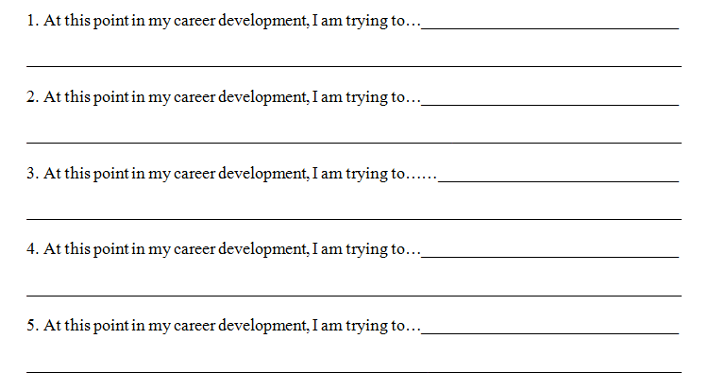
Part 2. Next, please rate each of your five career development strivings (S1-S5) based on the following questions, using the following scale:
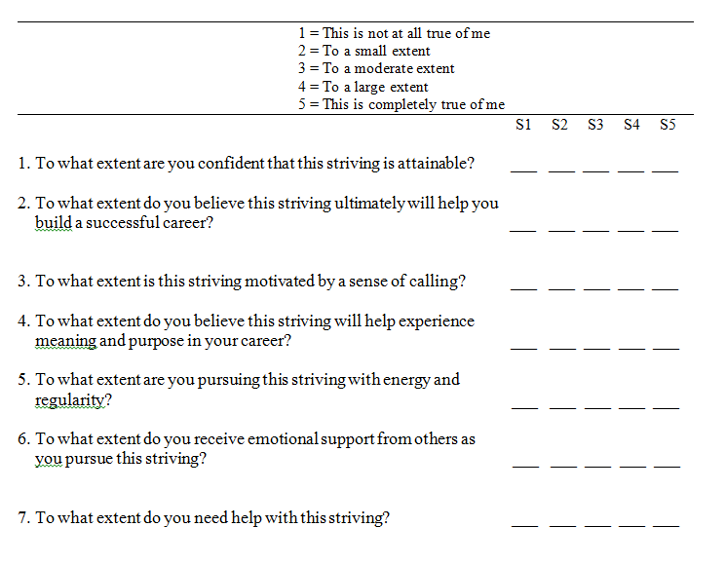
How do I use this? This exercise is based on a study that appeared in Journal of Career Development. In that study, we asked research participants to do essentially the same thing you just did. We found that ratings on the first criterion of part 2, which assess outcome expectations, were positively associated with career decision self-confidence and intrinsic motivation. Ratings on the second criterion of part 2 measure a sense of self-efficacy or confidence, and were related to intrinsic motivation and meaning in life. Ratings on the third criterion measure a sense of calling, and were associated with intrinsic commitment, meaning in life, and religious commitment.

The other ratings were not included in that study, but have proven helpful to our career counseling clients. The fourth set of ratings target motivations for meaning-making, the fifth target the level of social support you perceive, and the sixth target the sense of vigor and persistence you feel as you pursue each striving. In all six cases, if you have a lot of high ratings (e.g., mostly 4s and 5s), you are on track toward experiencing beneficial outcomes such as those we investigated in the Journal of Career Development study. If you have a lot of 1s and 2s, you probably are struggling with those strivings. This brings us to the seventh set of ratings, where you identified the extent to which you feel you need help with each striving. If those ratings are high, seek support! In Make Your Job a Calling, we recommend actively engaging the career development process with the help of friends, family, and trusted mentors in your life, as well as a trained career counselor. We also recommend both formal and informal assessments and self-help exercises. Whatever combination of resources and supports you use, take the reigns and engage the process actively. Doing so takes effort and hard work, but trust us, it will pay off.


[1] Dik, B. J., Sargent, A. M., & Steger, M. F. (2008). Career development strivings: Assessing goals and motivation in career decision-making and planning. Journal of Career Development, 35, 23-41.


Share this:

  • Email a link to a friend (Opens in new window) Email
  • Share on Facebook (Opens in new window) Facebook
  • Share on X (Opens in new window) X
  • Share on Tumblr (Opens in new window) Tumblr
  • Share on Pinterest (Opens in new window) Pinterest
  • Share on LinkedIn (Opens in new window) LinkedIn
  • More
  • Share on Reddit (Opens in new window) Reddit
  • Print (Opens in new window) Print
Like Loading...

What is jobZology?

September 27, 2012 · by Templeton Editor

jobZologyTM is a career assessment system currently being developed by Career Analytics Network, Inc., a start-up company in Fort Collins, Colorado, founded in partnership with Colorado State University.  jobZologyTM  is designed to provide high quality and low cost (that is, free!) assessment information to job seekers, along with resources to help navigate the career decision-making and development process.   jobZologyTM also includes a decision engine that directly connects job-seekers with employers on the basis of psychological fit, thus providing a more streamlined pathway for people to live out their callings, and for employers to quickly find people who fit their open positions and organizational culture well.  Bryan Dik, coauthor of Make Your Job a Calling, is a cofounder and current chief science officer for the company.  For more information or to register for updates, go to www.jobzology.com.

Share this:

  • Email a link to a friend (Opens in new window) Email
  • Share on Facebook (Opens in new window) Facebook
  • Share on X (Opens in new window) X
  • Share on Tumblr (Opens in new window) Tumblr
  • Share on Pinterest (Opens in new window) Pinterest
  • Share on LinkedIn (Opens in new window) LinkedIn
  • More
  • Share on Reddit (Opens in new window) Reddit
  • Print (Opens in new window) Print
Like Loading...

You at Your Best

September 27, 2012 · by Templeton Editor

In Chapter 4 of Make Your Job a Calling, we note that one informal strategy for assessing your strengths is to think carefully about a recent situation when you were at your best. Give it a shot. Start by identifying the situation, a specific event within the last few weeks in which you felt you were clearly at your best. Got it? Now, replay it in your mind a few times, focusing carefully on the details of the moment. In a journal or on another sheet (because you will need space for this), write out answers to these questions:

  • Using a step-by-step account, how did the events of this situation unfold?
  • What did you do well?
  • What was the outcome?
  • Thinking back on it, what specific personal strengths did you show in this situation? List as many as you can.
  • Circle or highlight the top five. In which other situations have you observed these strengths?

Once you have those top five strengths, try this experiment: Make a conscious, deliberate effort to use these strengths more often, and in new ways, in your job (or in other areas of your life, if you are not currently employed) every day for the next week. Over the course of that week, as you do this, what do you notice or experience? In what ways has using these strengths changed the way you feel about your work?

Martin Seligman and colleagues have shown that people instructed to write about a “you at your best” experience, reflect on their personal strengths illustrated in the story, and then review the story once a day for a week to further reflect on their strengths were significantly happier and less depressed compared to people in a control group at the end of that week.[1] However, these effects didn’t last into the weeks and months that followed. Why not? One explanation is that merely reflecting on your strengths is not enough; you have to use them. Another finding from the same study supported that interpretation: Individuals who were given feedback on their top strengths, and who were then instructed to use one of their top strengths in a new and different way each day for a week, were significantly happier and less depressed not just at the end of that week but even six months later! Of course, these participants were instructed to use their strengths generally, not only at work, and happiness and depression are not the same thing as meaning. However, another recent study demonstrated that when people use their strengths at work, they are in fact more likely to experience their work as meaningful.[2] To summarize the obvious conclusion: Don’t stop at merely identifying your strengths, use them!


[1] Martin E. P. Seligman, Tracy A. Steen, Nansook Park, and Christopher Peterson, “Positive Psychology Progress: Empirical Validation of Interventions,” American Psychologist 60.5 (2005): 410–21.

[2] Hadassa Littman-Ovadia and Michael F. Steger, “Character Strengths and Well-Being among Volunteers and Employees: Towards an Integrative Model,” Journal of Positive Psychology 5.6 (2010): 419–30.

Share this:

  • Email a link to a friend (Opens in new window) Email
  • Share on Facebook (Opens in new window) Facebook
  • Share on X (Opens in new window) X
  • Share on Tumblr (Opens in new window) Tumblr
  • Share on Pinterest (Opens in new window) Pinterest
  • Share on LinkedIn (Opens in new window) LinkedIn
  • More
  • Share on Reddit (Opens in new window) Reddit
  • Print (Opens in new window) Print
Like Loading...

The Research Corner

September 27, 2012 · by Templeton Editor

Researchers in a variety of academic fields study what it means to discern and live out a calling. Results from these studies are often fascinating, even to people who don’t live in the academic world. in this section of the website, you’ll find some brief summaries of some of the newest, most cutting-edge studies that have been published on calling, with complete citations for those of you who want to check out the full article.

For example: In a recent article,  Read More →

Share this:

  • Email a link to a friend (Opens in new window) Email
  • Share on Facebook (Opens in new window) Facebook
  • Share on X (Opens in new window) X
  • Share on Tumblr (Opens in new window) Tumblr
  • Share on Pinterest (Opens in new window) Pinterest
  • Share on LinkedIn (Opens in new window) LinkedIn
  • More
  • Share on Reddit (Opens in new window) Reddit
  • Print (Opens in new window) Print
Like Loading...

Self-Help Strategies

June 28, 2012 · by Templeton Editor

There are several ways to figure out the type of job that might best suit you interests, skills, values, and personality. For starters, try one of these self-help exercises:

  • What does my ideal day look like in five years?
  • Values checklist
  • The career interview
  • Career development striving exercise
  • Career goals / Life goals assessment
  • You-at-your-best exercise

Share this:

  • Email a link to a friend (Opens in new window) Email
  • Share on Facebook (Opens in new window) Facebook
  • Share on X (Opens in new window) X
  • Share on Tumblr (Opens in new window) Tumblr
  • Share on Pinterest (Opens in new window) Pinterest
  • Share on LinkedIn (Opens in new window) LinkedIn
  • More
  • Share on Reddit (Opens in new window) Reddit
  • Print (Opens in new window) Print
Like Loading...

Tips for Job Hunters

June 28, 2012 · by Templeton Editor

You may not know this, but as you are reading this there are dozens of researchers who are studying the best way for people to find jobs. These researchers study people who are successful in the job search process and try to understand what factors helped them find success. Instead of pulling tips for you from a blog or job hunting site, below we present (in layman’s terms) some of the most important findings from this area of research. Read More →

Share this:

  • Email a link to a friend (Opens in new window) Email
  • Share on Facebook (Opens in new window) Facebook
  • Share on X (Opens in new window) X
  • Share on Tumblr (Opens in new window) Tumblr
  • Share on Pinterest (Opens in new window) Pinterest
  • Share on LinkedIn (Opens in new window) LinkedIn
  • More
  • Share on Reddit (Opens in new window) Reddit
  • Print (Opens in new window) Print
Like Loading...

Expanded Q&A

June 28, 2012 · by Templeton Editor

At the end of Make Your Job a Calling, we present a number of frequently asked questions that we answer to give a readers a clearer sense of what it means to discern, discover, and live out a calling. Of course, readers may have questions that are not addressed directly in the book.  If this is the case for you, please submit your question to us by entering it into the box below.  Check back later, because will post answers to representative questions on the site. Read More →

Share this:

  • Email a link to a friend (Opens in new window) Email
  • Share on Facebook (Opens in new window) Facebook
  • Share on X (Opens in new window) X
  • Share on Tumblr (Opens in new window) Tumblr
  • Share on Pinterest (Opens in new window) Pinterest
  • Share on LinkedIn (Opens in new window) LinkedIn
  • More
  • Share on Reddit (Opens in new window) Reddit
  • Print (Opens in new window) Print
Like Loading...

Calling Survey

June 28, 2012 · by Templeton Editor

Some people, when describing their careers, talk about having a “calling.”  Broadly speaking, a “calling” in the context of work refers to a person’s belief that she or he is called upon (by the needs of society, by a person’s own inner potential, by God, by Higher Power, etc.) to do a particular kind of work. Although at one time most people thought of a calling as relevant only for overtly religious careers, the concept is frequently understood today to apply to virtually any area of work.

The following questions assess the degree to which you see this concept as relevant to your own life and career.  Please respond honestly, not according to what is socially desirable or what you feel you “ought” to think.  Please indicate the extent to which each of the following statements currently describe you, using the following scale, keeping track of your scores as you go.

PART I: CALLING SCALE

1.  I have a calling to a particular kind of work. ­
1 = Not at all true of me
2 = Mildly true of me
3 = Moderately true of me
4 = Mostly true of me
5 = Totally true of me

2. I have a good understanding of my calling as it applies to my career.
1 = Not at all true of me
2 = Mildly true of me
3 = Moderately true of me
4 = Mostly true of me
5 = Totally true of me

PART II: LIVING A CALLING

Please answer the following items if you currently feel a calling to a particular job or line of work. Please answer using the following scale:

1. I have regular opportunities to live out my calling.
1 = Not at all true of me
2 = Mildly true of me
3 = Moderately true of me
4 = Mostly true of me
5 = Totally true of me

2. I am currently working in a job that closely aligns with my calling.
1 = Not at all true of me
2 = Mildly true of me
3 = Moderately true of me
4 = Mostly true of me
5 = Totally true of me

3. I am consistently living out my calling.
1 = Not at all true of me
2 = Mildly true of me
3 = Moderately true of me
4 = Mostly true of me
5 = Totally true of me

4. I am currently engaging in activities that align with my calling.
1 = Not at all true of me
2 = Mildly true of me
3 = Moderately true of me
4 = Mostly true of me
5 = Totally true of me

5. I am living out my calling right now in my job.
1 = Not at all true of me
2 = Mildly true of me
3 = Moderately true of me
4 = Mostly true of me
5 = Totally true of me

6. I am working in a job to which I feel called.
1 = Not at all true of me
2 = Mildly true of me
3 = Moderately true of me
4 = Mostly true of me
5 = Totally true of me

SCORING
Please follow the links below that correlate to your scores on the two scales.

  • Calling scale sum: 2 / Living calling scale sum: Does not apply in this case
  • Calling scale sum: 3-7 / Living calling scale sum: 6
  • Calling scale sum: 3-7 / Living calling scale sum: 7-24
  • Calling scale sum: 3-7 / Living calling scale sum: 25-30
  • Calling scale sum: 8-10 / Living calling scale sum: 6
  • Calling scale sum: 8-10 / Living calling scale sum: 7-24
  • Calling scale sum: 8-10 / Living calling scale sum: 25-30


Share this:

  • Email a link to a friend (Opens in new window) Email
  • Share on Facebook (Opens in new window) Facebook
  • Share on X (Opens in new window) X
  • Share on Tumblr (Opens in new window) Tumblr
  • Share on Pinterest (Opens in new window) Pinterest
  • Share on LinkedIn (Opens in new window) LinkedIn
  • More
  • Share on Reddit (Opens in new window) Reddit
  • Print (Opens in new window) Print
Like Loading...

Career Assessments

June 28, 2012 · by Templeton Editor

Are all career assessments created equal? If not, are there ways to judge which ones are better than others?  Career assessments vary widely in their quality, and yes, there are good ways to judge which are better than others. Career assessments are only good if they succeed at reliably and validly measuring what they claim to measure. Read More →

Share this:

  • Email a link to a friend (Opens in new window) Email
  • Share on Facebook (Opens in new window) Facebook
  • Share on X (Opens in new window) X
  • Share on Tumblr (Opens in new window) Tumblr
  • Share on Pinterest (Opens in new window) Pinterest
  • Share on LinkedIn (Opens in new window) LinkedIn
  • More
  • Share on Reddit (Opens in new window) Reddit
  • Print (Opens in new window) Print
Like Loading...

Choosing a Career Counselor

June 28, 2012 · by Templeton Editor

Visiting a career counselor is an important step that can help you better understand what your calling may be and how to live it out to the fullest. Below we present strategies for how to choose a career counselor that is best for you. There are a number of different titles of professionals who provide career counseling (e.g., coach, consultant, counselor); here we discuss career counselors specifically. These are professionals who have at least a master’s degree and, are certified, meaning they received a degree from an accredited program and have passed a national licensing exam similar the bar exam for lawyers. These strategies for choosing a counselor come primarily from two sources: the guidelines for choosing a counselor published by the National Career Development Association (NCDA) and the suggestions made by Richard Bolles in his book What Color is Your Parachute?  Read More →

Share this:

  • Email a link to a friend (Opens in new window) Email
  • Share on Facebook (Opens in new window) Facebook
  • Share on X (Opens in new window) X
  • Share on Tumblr (Opens in new window) Tumblr
  • Share on Pinterest (Opens in new window) Pinterest
  • Share on LinkedIn (Opens in new window) LinkedIn
  • More
  • Share on Reddit (Opens in new window) Reddit
  • Print (Opens in new window) Print
Like Loading...
Page 2 of 3 « Previous 1 2 3 Next »
  • Tweets from Ryan Duffy

    Tweets by DrRyanDuffy

    Tweets from Bryan Dik

    Tweets by bryandik
  • Ryan D. Duffy

    Ryan is assistant professor of psychology at the University of Florida. His research is primarily in the area of vocational psychology, and his topics of interest include calling, job satisfaction, work volition, work values, and the interface of spirituality and work.
  • Bryan J. Dik

    Bryan is associate professor of psychology at Colorado State University and cofounder and chief science officer of Career Analytics Network/jobZology. His research targets calling, meaningful work, religion and workplace spirituality, vocational interests, and career development interventions.
  • Create a free website or blog at WordPress.com.
Privacy & Cookies: This site uses cookies. By continuing to use this website, you agree to their use.
To find out more, including how to control cookies, see here: Cookie Policy
  • Subscribe Subscribed
    • Make Your Job a Calling
    • Already have a WordPress.com account? Log in now.
    • Make Your Job a Calling
    • Subscribe Subscribed
    • Sign up
    • Log in
    • Report this content
    • View site in Reader
    • Manage subscriptions
    • Collapse this bar
 

Loading Comments...
 

    %d