
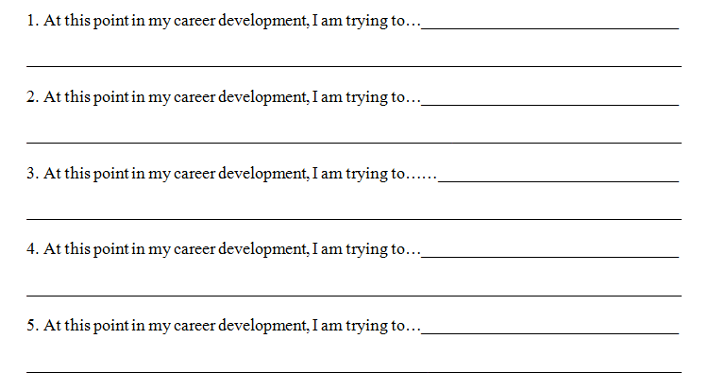
There are two parts to this exercise. The first asks you to identify five things that you are currently striving for in your career. The second asks you to rate each of those “strivings” along seven criteria. Give this a shot, then read on.
Part 1. Consider the activities you are currently engaging in to help you build a successful career. We might call these types of activities “career development strivings.” Be as honest and as objective as possible; do not simply give socially desirable strivings or strivings you think you “ought” to have. Please write down what you currently consider to be the 5 most important career development strivings in your life.
Part 2. Next, please rate each of your five career development strivings (S1-S5) based on the following questions, using the following scale:
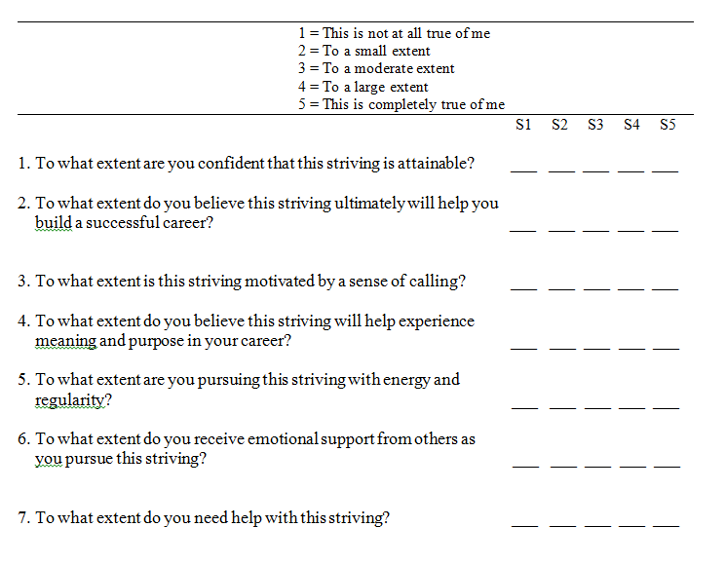
How do I use this? This exercise is based on a study that appeared in Journal of Career Development. In that study, we asked research participants to do essentially the same thing you just did. We found that ratings on the first criterion of part 2, which assess outcome expectations, were positively associated with career decision self-confidence and intrinsic motivation. Ratings on the second criterion of part 2 measure a sense of self-efficacy or confidence, and were related to intrinsic motivation and meaning in life. Ratings on the third criterion measure a sense of calling, and were associated with intrinsic commitment, meaning in life, and religious commitment.
The other ratings were not included in that study, but have proven helpful to our career counseling clients. The fourth set of ratings target motivations for meaning-making, the fifth target the level of social support you perceive, and the sixth target the sense of vigor and persistence you feel as you pursue each striving. In all six cases, if you have a lot of high ratings (e.g., mostly 4s and 5s), you are on track toward experiencing beneficial outcomes such as those we investigated in the Journal of Career Development study. If you have a lot of 1s and 2s, you probably are struggling with those strivings. This brings us to the seventh set of ratings, where you identified the extent to which you feel you need help with each striving. If those ratings are high, seek support! In Make Your Job a Calling, we recommend actively engaging the career development process with the help of friends, family, and trusted mentors in your life, as well as a trained career counselor. We also recommend both formal and informal assessments and self-help exercises. Whatever combination of resources and supports you use, take the reigns and engage the process actively. Doing so takes effort and hard work, but trust us, it will pay off.
[1] Dik, B. J., Sargent, A. M., & Steger, M. F. (2008). Career development strivings: Assessing goals and motivation in career decision-making and planning. Journal of Career Development, 35, 23-41.
 Make Your Job a Calling
Comments
Trackbacks & Pingbacks